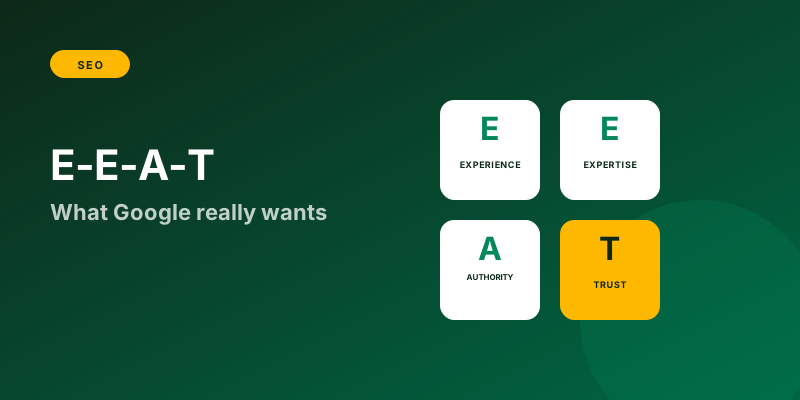
E-E-A-T (Experience, Expertise, Authoritativeness, Trustworthiness) is the framework Google's Quality Raters use. Here is how to translate it into concrete page-level signals.
E-E-A-T isn't a single ranking signal. It's a framework Google's human Quality Raters use to evaluate page quality, which then trains Google's ranking models. Translating it into concrete page-level changes is what moves rankings.
The four letters explained
- Experience — has the author personally done what they're writing about?
- Expertise — does the author have demonstrated subject-matter knowledge?
- Authoritativeness — is the author / site recognised as a go-to source?
- Trustworthiness — can users trust the page, the author, and the site?
Trustworthiness is the most important; the other three feed into it. A high-T page wins even if E/E/A are moderate. A low-T page loses no matter how strong the other three are.
Experience signals (page-level)
Experience is the newest E (added in 2022). For YMYL (Your Money Your Life) topics — health, finance, legal — Google explicitly wants first-hand experience.
- First-person language: "I tried this", "We've handled 1,200 cases", "After 6 months using X..."
- Original photos / screenshots / videos (not stock)
- Specific dates, numbers, named people, named products
- Counter-intuitive findings — what you learned that contradicted received wisdom
- "What I would do differently" sections
Expertise signals (author-level)
- Visible author byline on every editorial page
- Author bio page with credentials (degrees, certifications, years of experience)
- Schema.org
PersonwithjobTitle,alumniOf,sameAs - Author's LinkedIn / academic / professional profile linked
- Publications, awards, speaking engagements listed
Authoritativeness signals (site-level)
- Mentions in trusted publications (Wikipedia, mainstream press, industry journals)
- Backlinks from authoritative domains in your niche
- Wikipedia / Wikidata entry for your brand or organisation
- Industry awards, certifications, professional body memberships
- Long-running domain (Google does measure age + consistency)
Trustworthiness signals (page + site)
Trust is the foundation. Without it, the other three don't matter:
- HTTPS, valid SSL, security headers
- Clear contact information (real email, phone, address)
- Visible business identity (registered company name, number, jurisdiction)
- Privacy policy, terms of service, refund policy — actual ones, not templates
- Customer reviews (visible, balanced, recent)
- No deceptive practices (hidden fees, dark patterns, fake testimonials)
- Up-to-date content with explicit "Last updated" dates
- Citations / sources for factual claims
The YMYL multiplier
For YMYL pages (anything that could affect health, finances, safety, or major life decisions), Google applies E-E-A-T scrutiny at maximum. If you're in YMYL:
- Author credentials become near-mandatory (M.D., CFP, JD, licensed practitioner)
- Sources must be cited (peer-reviewed journals, government data, regulatory bodies)
- Generic content from anonymous "content writers" will not rank
- Disclaimers and accurate caveats are expected
Concrete page-level changes
If you want to improve E-E-A-T on a single page, in priority order:
- Add a visible byline with author photo + role
- Add "Last updated: [date]" near the title
- Add a "Reviewed by" line if you have an expert reviewer
- Add 3+ source citations to authoritative external pages
- Include personal experience markers ("In our work with X clients, we've found Y")
- Add a contextual author bio at the end
- Deploy
Articleschema withauthor,datePublished,dateModified
What kills E-E-A-T
- Anonymous "Admin" or no byline at all
- Wall of AI-generated content with no human verification or original insight
- No contact information beyond a contact form
- Outdated content with no update dates
- Unverified claims (especially numerical)
- Stock photos that pretend to be original
- Fake testimonials or fake reviews
- Deceptive page design (ads disguised as content, hidden fees)
How E-E-A-T compounds with AEO and GEO
E-E-A-T signals also matter for AI search engines. LLMs are increasingly trained to favour sources with strong author bios, citations, recency markers, and entity recognition. The same investments that lift classic rankings also boost AI citation rates — see our GEO guide for more.
Quick E-E-A-T audit
Open any of your top 5 pages. Score 1-5 on each:
- Can I tell who wrote this? (Experience proxy)
- What credentials does the author have? (Expertise)
- What are the site's third-party signals? (Authoritativeness)
- Would I trust this page enough to act on the advice? (Trust)
Anything below 3 needs work. The improvements are usually mechanical — add the byline, add the date, add the citations, add the contact info.
Get an objective audit
Our €50 SEO Audit includes E-E-A-T scoring on your top 10 pages with specific fixes per page.
MediaServere is a UK-registered SEO agency (MEDIASERVERE LTD, #16540150) helping European businesses rank in classic and AI search. Specialising in SEO, AEO, GEO, backlinks and web design — packages from €50. More about us →