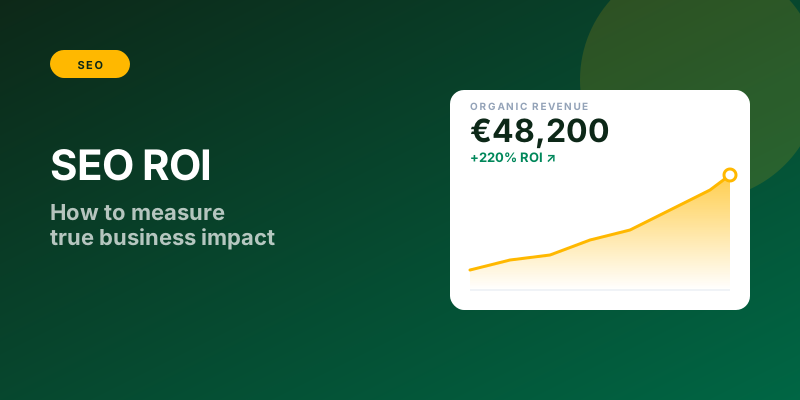
SEO ROI is hard to measure but critical to justify. Here is a practical framework: KPIs that matter, attribution models, tools, and stakeholder reporting.
"What's the ROI of our SEO?" is the question that ends most SEO programmes prematurely. Getting it right requires honest measurement, sensible attribution, and the discipline to wait long enough for compound effects to show up.
The KPI hierarchy
Most SEO reports show too many metrics. Strip it back to a layered set:
Output metrics (what we do)
- Pages optimised / created / linked-from
- Backlinks acquired
- Technical issues resolved
Useful for tracking work, useless for proving impact.
Outcome metrics (what changed)
- Organic impressions (Search Console)
- Organic clicks (Search Console)
- Position for tracked keywords
- Indexed pages
Closer to impact, but still not revenue.
Business metrics (what mattered)
- Organic-sourced leads (form submissions, demo requests, calls)
- Organic-sourced revenue (closed-won)
- Customer acquisition cost from organic vs paid
- Lifetime value of organic-sourced customers
This is the layer that justifies the budget.
Attribution: the honest version
SEO often gets the first touch (someone found you via search) but not the last touch (they came back direct or via brand search to convert). Last-click attribution underreports SEO impact dramatically.
Models that actually help
- First-touch: Credits SEO when it generates initial awareness
- Position-based (40-20-40): Splits credit between first + last with assists in middle
- Data-driven (GA4): Machine-learning attribution; reasonable approximation if you have volume
- Self-reported: "How did you hear about us?" on lead forms — slow but real
For most B2B / lead-gen businesses, run two reports: last-click (the floor) and first-touch (the ceiling). Reality is somewhere between.
Setting up tracking
Google Analytics 4
- Conversion events for every meaningful action (form submission, call, sign-up, purchase)
- UTM parameters on every campaign you control
- "Organic search" channel grouping kept clean
- Cross-domain tracking if you have multiple properties
Google Search Console
- Property verified (preferably Domain property, not URL prefix)
- Performance report bookmarked for impressions/clicks/CTR/position
- Coverage report monitored for indexing issues
- Filtered by Country / Device for segmentation
Rank tracker (optional)
SearchAtlas, AccuRanker, SE Ranking — useful for tracking specific keyword positions over time. Less useful in the AI-search era; supplement with citation tracking (see our AEO guide).
CRM integration
Tag leads with traffic source. Track conversion rate and revenue per channel inside the CRM. Without this you can't measure business impact.
The reporting framework
For monthly SEO reports to stakeholders, use a three-layer structure:
Page 1: The bottom line
"Organic generated N leads worth £X this month, up Y% vs last month." Two sentences. Then a single chart showing 12-month trend.
Page 2: The leading indicators
Impressions, clicks, position, indexed pages. Why does the bottom line look the way it does?
Page 3: What we did
Specific deliverables shipped this month. New pages, optimisations, backlinks, technical fixes.
Skip the 40-page dashboard. Most stakeholders read the first page and skim the rest.
The time-horizon honesty
Be upfront about timelines:
- Month 1-3: Output metrics; indexing changes; minor ranking moves on long-tail
- Month 3-6: Meaningful ranking improvements on target keywords
- Month 6-12: Material traffic / lead-volume changes
- Year 2+: Compound effects; topical authority pays off
If a stakeholder expects revenue impact in month 2, manage expectations upfront — or don't start.
Calculating ROI
Basic formula:
SEO ROI = (Organic-sourced Revenue × Margin) − SEO Cost
         ─────────────────────────────────────────────────
                              SEO Cost
Example: SEO costs €500/month. Organic generates €4,000/month in revenue at 40% margin. Net benefit = €1,600 − €500 = €1,100/month. ROI = 220%.
The "vs paid" comparison
To make SEO defensible internally, calculate the equivalent paid-search spend:
- Take your top 10 organic ranking keywords
- Look up their Google Ads CPC
- Multiply by your organic click volume per keyword
- Sum it — that's the "cost avoided" by ranking organically
Example: if organic delivered 10,000 clicks at an average paid CPC of €2.50, that's €25,000 of "saved" ad spend.
Common ROI mistakes
- Counting impressions as outcomes. Impressions don't pay bills.
- Last-click only. Drastically undersells SEO contribution.
- Ignoring brand search. A growing brand search trend is often a downstream effect of content SEO.
- Comparing month-over-month not year-over-year. Seasonality distorts MoM; YoY shows real trend.
- Not segmenting by intent. Informational traffic ≠ commercial traffic. Track separately.
If your ROI looks bad
Before cutting SEO spend:
- Are you attributing correctly?
- Are you measuring the right outcome?
- Has enough time passed?
- Is the work itself good, or is it generic activity?
- Could a tactical pivot (more commercial pages, fewer top-funnel articles) shift the ratio?
Start with the right audit
Our €50 SEO Audit includes a baseline measurement framework so future ROI calculations have a starting point. If you don't have GA4 and Search Console set up, we'll flag it and provide setup steps.
MediaServere is a UK-registered SEO agency (MEDIASERVERE LTD, #16540150) helping European businesses rank in classic and AI search. Specialising in SEO, AEO, GEO, backlinks and web design — packages from €50. More about us →